 ENG
 INA
Udayana University Postgraduate School Holds Vision and Mission Workshop to Strengthen Local Excellence and Global Competitiveness
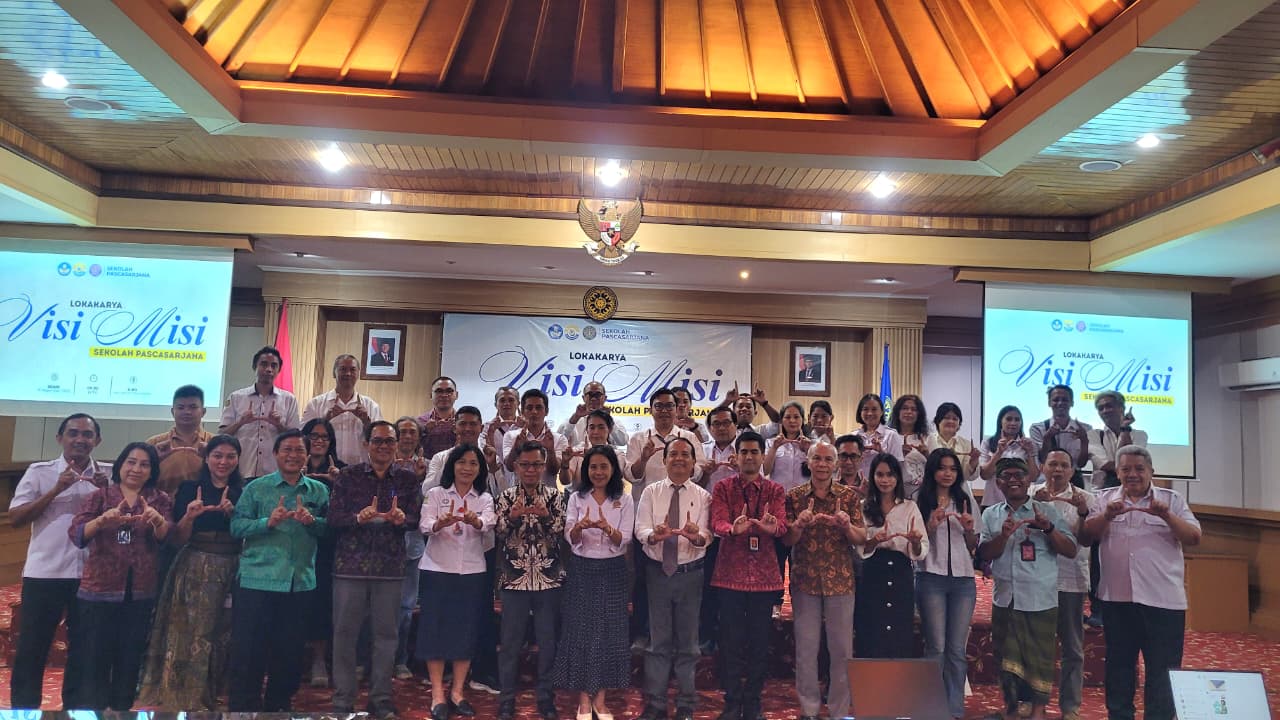
The Postgraduate School of Udayana University held a Vision and Mission Workshop on Monday (November 16, 2026), as a strategic initiative to align the institution's and study programs' development directions with Udayana University's vision and mission following its transition to a State-Owned Legal Entity University (PTN-BH). The workshop provided a forum to strengthen academic excellence, integrate Balinese local wisdom, and enhance global competitiveness.
DENPASAR –
The Postgraduate School of Udayana University held a Vision and Mission Workshop on Monday, November 16, 2026. Taking place from 9:00 a.m. to 12:00 p.m. Central Indonesian Time (WITA), the event aimed to align the vision and mission of the Postgraduate School and its study programs with Udayana University's institutional development direction following its transition to a State-Owned Legal Entity University (PTN-BH).
The workshop was led by the Director of the Postgraduate School, Prof. I Nyoman Suprapta Winaya, S.T., MA.Sc., Ph.D., together with Prof. Ir. Ida Ayu Astarini, M.Sc., Ph.D. Participants included institutional leaders, lecturers, administrative staff, students, alumni, external partners, hospital representatives, and other stakeholders.
Discussions focused on strengthening institutional excellence, international standards, developing Bali's local identity, ensuring graduate competencies meet workforce demands, and establishing measurable indicators to evaluate the achievement of the institution's vision and mission.
During the discussion, Prof. I Nyoman Suprapta Winaya emphasized that each study program must thoroughly understand the vision being formulated. Claims of excellence must be supported by specific characteristics and strengths that distinguish graduates of Udayana University's Postgraduate School from graduates of other higher education institutions.
These strengths must be translated into clear and measurable achievement indicators. Therefore, the institutional vision should serve not merely as a formal statement but also as a guideline for academic development.
Internationalization was another important issue discussed during the workshop. A representative of the Financial Services Authority (OJK) raised questions regarding the international standards that would serve as references in formulating the vision and mission. In response, Prof. Suprapta Winaya explained that international higher education standards could refer to international accreditation frameworks implemented by independent accreditation agencies.
Meanwhile, Prof. Ir. Ida Ayu Astarini explained that several faculties and study programs at Udayana University had begun pursuing international accreditation, including the Faculty of Economics and Business through FIBAA and the Faculty of Mathematics and Natural Sciences through ASIIN. Study programs within the Postgraduate School that have achieved Excellent accreditation are expected to begin preparing for international accreditation requirements.
Prof. Dr. Ir. I Wayan Arthana also emphasized that internationalization must be supported by concrete performance indicators. These may include the number of international students, international publications, lecturers' participation in global academic activities, and international academic recognition. He also highlighted the importance of implementing an Outcome-Based Education (OBE) curriculum aligned with international standards.
Defining the identity, characteristics, and strengths of each study program through measurable achievement indicators.
Promoting OBE-based curricula, international accreditation, scientific publications, and stronger global academic networks.
Integrating Balinese culture and the Tri Hita Karana philosophy as an institutional identity with a global outlook.
In addition to internationalization, strengthening Balinese local wisdom emerged as one of the workshop's central themes. Representatives of students and alumni from the Ergonomics and Work Physiology Study Program highlighted Bali's local potential as an institutional identity and a strategic strength in global competition.
Education, research, and community service activities are expected to integrate local cultural values to address regional challenges while contributing to broader development.
This perspective was also reflected in the input from the Chairperson of ARSSI Bali, who highlighted opportunities in health and tourism development, particularly health tourism. Postgraduate graduates are expected to possess competencies relevant to the needs of healthcare facilities that are moving toward international standards.
Bali's cultural potential, including the Tri Hita Karana philosophy, as well as the development of wellness and traditional Balinese medicine, was also identified as a potential strength in developing health-based tourism.
The development of Udayana University's Postgraduate School must integrate academic excellence, international standards, and Balinese local wisdom to produce competitive graduates and deliver meaningful contributions to society.
The development of academic disciplines was another important topic addressed during the workshop. Prof. Dr. I Wayan Gede Astawa Karang explained that Udayana University's transition to PTN-BH provides greater institutional autonomy, which must be balanced with accountability and institutional independence.
He encouraged the development of academic approaches from multidisciplinary toward transdisciplinary collaboration, enabling the Postgraduate School to generate solutions to complex challenges. Academic excellence must also be demonstrated through research outcomes and innovations that deliver tangible impacts.
Strengthening partnerships with government institutions, universities, hospitals, businesses, and other stakeholders was also highlighted. Such collaborations are expected to improve graduate relevance to workforce needs and expand the downstream application of research outcomes.
Another important discussion concerned how to measure the achievement of a long-term institutional vision. Prof. Dr. I Wayan Gede Astawa Karang explained that the vision's implementation could be translated into short-, medium-, and long-term strategic objectives and targets.
Through this approach, the institution can maintain a long-term vision while evaluating its progress annually through established performance indicators. Targets and milestones must also be realistic to provide clear guidance for implementing institutional programs.
In her response, Prof. Ir. Ida Ayu Astarini emphasized the importance of translating the vision and mission into concrete academic implementation. Each study program must ensure that institutional development priorities are reflected in curricula, courses, research activities, community service, and academic governance.
The Postgraduate School of Udayana University has also integrated the Sustainable Development Goals (SDGs) and local wisdom values into its academic development. Strengthening collaboration across academic disciplines is expected to position the Postgraduate School as a platform for multidisciplinary and transdisciplinary knowledge development.
Based on the workshop discussions, several follow-up actions were identified. These include reviewing and compiling all participants' input, coordinating with all study program coordinators, identifying the distinctive strengths of each study program, and establishing measurable indicators accompanied by clear targets and timelines.
In addition, the Postgraduate School will promote the integration of Tri Hita Karana values, the SDGs, local wisdom, and transdisciplinary approaches into the implementation of the Three Pillars of Higher Education (Tridharma Perguruan Tinggi). Study programs' readiness to meet international accreditation standards and stronger communication and cooperation with external partners will also receive attention.
Student feedback regarding improvements in the delivery of academic information and announcements through the IMISSU system was also recorded as an issue for the Postgraduate School leadership to address.
The workshop represents an important step in the Postgraduate School of Udayana University's efforts to establish a clear institutional identity and academic excellence rooted in Bali's local potential while responding to global higher education challenges. Through the refinement of its vision and mission, supported by measurable achievement indicators, the Postgraduate School is expected to strengthen educational quality, produce graduates who meet societal and workforce needs, and expand its contribution to sustainable development.
Strengthening the Excellence and Identity of the Postgraduate School
Advancing International Standards and Global Accreditation
Academic Excellence
International Standards
Balinese Local Wisdom
Balinese Local Wisdom as a Global Competitive Advantage
Strengthening Multidisciplinary and Transdisciplinary Collaboration
A Long-Term Vision Supported by Measurable Indicators
Formulating Follow-Up Actions and Refining the Vision and Mission
UDAYANA UNIVERSITY