 ENG
 INA
Unud Postgraduate School Maps Curriculum Gaps in Low-Carbon Building
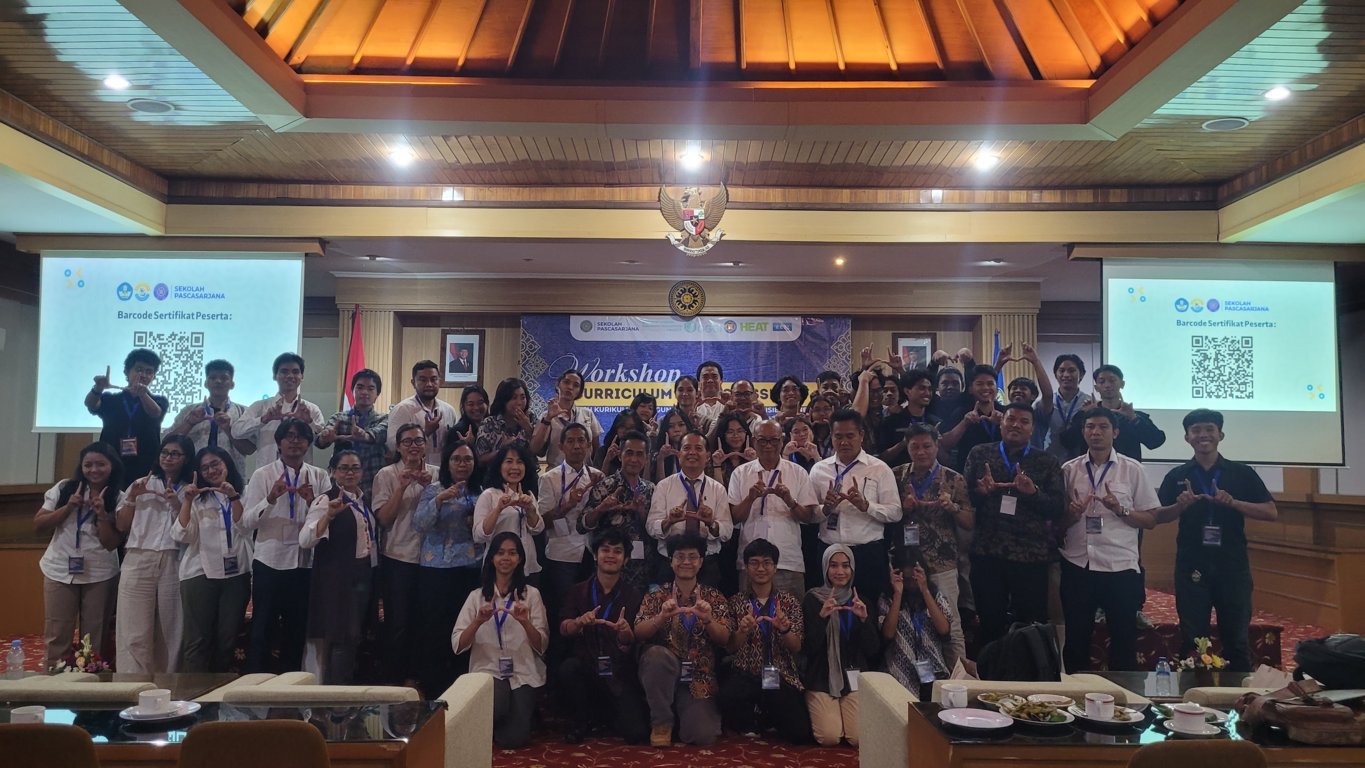
The Graduate School of Universitas Udayana, in collaboration with HEAT GmbH, held the Curriculum Gap Assessment – Low Carbon Building Workshop on Monday, 23 November 2026, at the Graduate School Building's third-floor auditorium. The event brought together academics, government representatives, industry practitioners, professional associations, and alumni to identify gaps between the existing curriculum and workforce needs in the field of low-carbon buildings.
DENPASAR – The Graduate School of Universitas Udayana (Unud), in collaboration with HEAT GmbH, held the Curriculum Gap Assessment – Low Carbon Building Workshop on Monday, 23 November 2026, at the third-floor auditorium of the Unud Graduate School Building. The workshop involved lecturers and students from the Architecture and Mechanical Engineering Study Programs, as well as representatives from local government, industry, professional associations, and alumni. The forum aimed to identify gaps between the current curriculum and the competencies required by the workforce in the low-carbon building sector.
The event forms part of the Asia Low Carbon Buildings Transition (ALCBT) project, funded by the German Government's International Climate Initiative (IKI). Under this project, Unud has been selected as a university partner. In 2026, the grant was awarded to only four universities in Indonesia: Universitas Gadjah Mada (UGM), Universitas Indonesia (UI), Universitas Udayana, and Universitas Multimedia Nusantara (UMN). Unud is the only recipient located outside Java.
In his opening remarks, Director of the Unud Graduate School, Prof. Ir. I Nyoman Suprapta Winaya, S.T., M.A.Sc., Ph.D., emphasized that building quality is determined not only by aesthetics, but also by material selection and energy efficiency.
“A good building should be beautiful in its appearance, wise in its physical form, and sustainable in its performance.”
The statement highlights the importance of combining artistic design, appropriate material choices, and energy efficiency in building design. Prof. Suprapta Winaya also explained that the approach to strengthening low-carbon perspectives would be integrative rather than disruptive. This means that low-carbon building topics will be incorporated into existing courses.
ALCBT Country Manager at HEAT GmbH, Herlin Herlianika, presented an overview of the ALCBT project and explained the role of university curricula in preparing professionals for the low-carbon building sector. HEAT GmbH reaffirmed its support for Unud through lecturer training, the use of the Building Energy Assessment Tool (BEAT), the development of teaching modules, and the preparation of a Massive Open Online Course (MOOC).
Strengthening knowledge and the application of energy efficiency in building design and management.
Introducing building emissions assessment and the use of BEAT as an analytical tool.
Promoting life-cycle thinking, including discussions on materials, financing, and retrofitting existing buildings.
The workshop also featured presentations on low-carbon building training modules by HEAT GmbH and the initial curriculum mapping results delivered by the Unud Curriculum Team. The following panel session brought together the Badung Regency Public Works and Spatial Planning Office, Archipelago International Hotels, Golden Teknik Bali, PT Indrakila Villatama Development, the Indonesian Institute of Architects (IAI) Bali, and the Green Building Council Indonesia (GBCI) Bali.
Following the panel session, participants were divided into six discussion groups. Each group was facilitated by HEAT GmbH and the ASEAN Centre for Energy (ACE) to complete the gap assessment matrix. The discussions covered energy efficiency, building emissions assessment, financing, and the retrofitting of existing buildings.
The initial assessment found that Unud's curriculum already has a strong foundation in building systems. However, several aspects have not yet been explicitly incorporated into the curriculum, particularly carbon awareness, life-cycle thinking, and the use of the Building Energy Assessment Tool (BEAT).
The curriculum is already strong in building systems, but it needs clearer integration of carbon awareness, life-cycle thinking, and the use of BEAT into the learning process.
All participant feedback will be compiled by the Formulation Team into recommendations for improving the Semester Learning Plans (RPS) and teaching materials. These recommendations are scheduled for further discussion at a follow-up workshop planned for March 2027.
The enhanced curriculum, incorporating low-carbon building perspectives, is targeted for adoption beginning in 2028. Learning activities will also be strengthened through the development of a MOOC, which is planned to be made available on the OASE platform.
Through the Curriculum Gap Assessment – Low Carbon Building Workshop, the Graduate School of Universitas Udayana seeks to ensure that the Architecture and Mechanical Engineering curricula become more relevant to the needs of low-carbon building development. Collaboration with HEAT GmbH, government institutions, industry, professional associations, and alumni is an important part of identifying competency needs and formulating curriculum improvements. The assessment is expected to provide a foundation for strengthening Semester Learning Plans, teaching materials, and learning initiatives that support the transition towards low-carbon buildings.
Low-Carbon Buildings as a Direction for Competency Development
Prof. Ir. I Nyoman Suprapta Winaya, S.T., M.A.Sc., Ph.D.
HEAT GmbH Supports Curriculum Development and Lecturer Capacity Building
Energy Efficiency
Emissions Assessment
Building Life Cycle
Bringing Together Government, Industry, and Professional Associations
Initial Assessment Identifies Curriculum Gaps
Curriculum Recommendations Scheduled for Further Discussion in 2027
UDAYANA UNIVERSITY